Water Coming Into Your House During Heavy Rain? How to Tell Flood, Wind-Driven Rain, a Roof Leak or Sewer Backup Apart, What to Do First, and How Insurance Usually Decides
Published
How water got in usually decides which policy, if any, responds. What to do first, and how flood, wind-driven rain, roof leaks, seepage and sewer backup differ.
Does homeowners insurance cover rainwater that came into my house?
Short answer: It depends on how the water got in. Triple-I says standard homeowners policies exclude flood, and FloodSmart says rain that builds up outside and flows into a home is treated as a flood, which is a flood insurance question. Rain that comes in because wind or hail damaged the roof or a wall is a different situation that homeowners or wind coverage may handle. Many policies don't pay for rain that blows in through an undamaged window, door or vent, and seepage or a slow leak is usually treated as maintenance. Read the water and rain wording in your own policy; only your insurer decides.
Is water coming up through my floor drain a flood?
Short answer: Not automatically. FloodSmart says flood insurance covers a sewer or drain backup only if a flood caused it, for example a sewer that backed up during a heavy rainstorm that flooded the area, and not a backup from clogged pipes. Triple-I says sewer backup isn't covered by a typical homeowners policy either unless you added a water backup endorsement, so check your declarations page for one.
What counts as a flood for flood insurance?
Short answer: The NFIP defines a flood as a general and temporary condition where two or more acres of normally dry land, or two or more properties (one of them yours), are partly or completely covered by water from overflowing inland or tidal waters, unusual and rapid runoff of surface water, or mudflow. Water pooling against one house from a blocked gutter may not meet that definition; street flooding that reached several homes usually would. Only your flood insurer decides.
Can I still buy flood insurance before this storm?
Short answer: You can buy it, but FloodSmart says NFIP coverage generally goes into effect 30 days after purchase, with a few exceptions, such as buying it in connection with making, increasing, extending or renewing a mortgage loan. It won't help with flooding from a storm that is already here, but it can protect you for the rest of the season. Private flood policies may have different waiting periods.
The short version
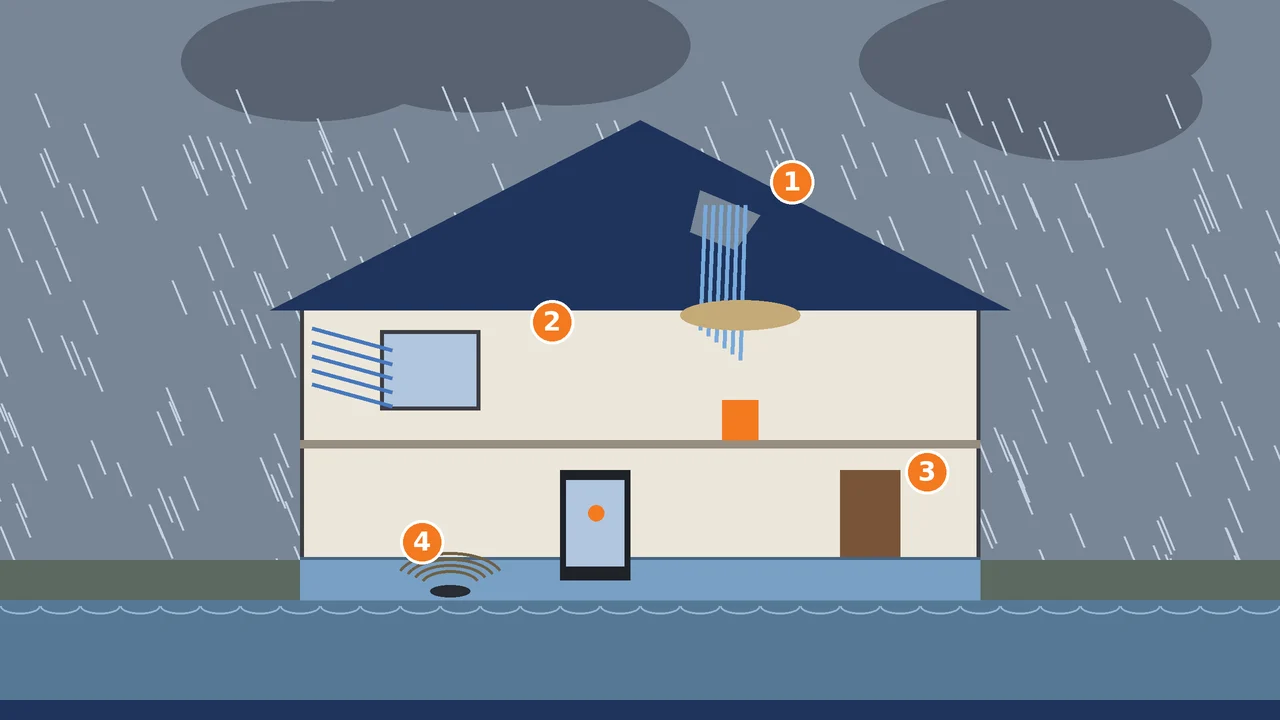
When water comes into a house during a downpour, the path it took usually decides which policy, if any, responds. Rain that collected outside and flowed in is usually treated as flood. Rain that came through a hole the storm tore in the roof or a wall is usually a homeowners or wind question. Water from a burst pipe or appliance is a homeowners question. Seepage through a foundation and slow leaks are usually treated as maintenance and not covered. Sewer and drain backup usually needs its own endorsement unless a flood caused it. So before you clean up, figure out and photograph where the water came in. That record helps whoever looks at the claim and helps a contractor fix the real cause.
Safety first
Don't walk or drive through floodwater. The National Weather Service says 6 inches of fast-moving water can knock over an adult and 12 inches of rushing water can carry away most cars. NWS also says not to go into a basement or any room if water covers the outlets or cords are underwater, and to get out if you see sparks or hear buzzing, crackling or popping. If you are told to evacuate, go. Move to a higher floor if water is rising, and only shut off power at the main breaker if you can reach it without standing in water.
Find and photograph where the water is coming in
Once it is safe, walk the house and the outside with your phone. Look for the source, not just the puddle. Signs it came from outside at ground level: a water line or mud on walls, water coming in under exterior doors or garage doors, standing water in the yard or street that reached the house, or water rising through the slab or basement floor. Signs it came from above: wet ceilings, drips from light fixtures, staining that spreads from the top of a wall, and missing shingles, lifted flashing, broken windows or other storm damage outside. Signs of a backup: water coming up through floor drains, toilets or tubs, especially if it smells like sewage. Take wide shots, close-ups and short videos of the source and the damage, with the date. If the street flooded, photograph that too: water covering several properties matters for how flood is defined.
Rain that collected outside and flowed in: usually flood
FloodSmart's guidance for agents says rain or snowmelt that accumulates and flows into a home is considered a flood and covered by flood insurance, not homeowners insurance. The NFIP definition requires a general and temporary condition covering two or more acres of normally dry land or two or more properties (one of which is yours), from overflowing inland or tidal waters, unusual and rapid runoff of surface waters, or mudflow. Triple-I says standard homeowners policies exclude flood. If you have an NFIP or private flood policy, report it to your flood insurer. If you don't, our guide to help after flooding without flood insurance covers FEMA and SBA options when a disaster is declared.
Rain through storm damage, and wind-driven rain
FloodSmart says damage from rain that is pushed into a home by wind, or that comes in through a damaged roof, is not covered by flood insurance and may be covered by a homeowners or renters policy or a wind rider. Many property policies are narrower than that, though. For example, the Texas Department of Insurance describes the TWIA dwelling policy's rain exclusion this way: damage caused by rain, whether driven by wind or not, isn't covered unless the direct force of wind or hail makes an opening in a roof or wall and the rain enters through that opening. Many homeowners policies have similar wording. In practice, rain through a hole a storm tore in the roof often falls under the wind or hail coverage of a homeowners policy, while rain blown through an intact window, door, vent or around old flashing may not be covered by either policy. Your policy wording controls, so read the rain and water sections, and photograph any roof, wall or window damage before it is tarped or repaired.
Seepage, slow leaks and poor drainage: usually maintenance
Triple-I says water seeping into a basement from the ground is excluded under the standard homeowners policy, and if the seepage isn't caused by a flood, a flood policy won't cover it either. The Washington State Office of the Insurance Commissioner says most homeowners policies don't cover gradual leaks, including water leaking through a foundation, cracks in walls or gaps between building materials, groundwater seepage, or damage that develops over more than a couple of days. Clogged gutters, downspouts dumping next to the foundation and yards graded toward the house are common causes. These usually aren't insurance claims, but they are worth fixing before the next storm.
Water coming up through drains or toilets: sewer backup
FloodSmart says flood insurance covers sewer backup only if it directly results from flooding, for example a sewer that backed up during a heavy rainstorm, and not a backup caused by clogged pipes. Triple-I says a typical homeowners policy doesn't cover sewer backup and that coverage has to be bought as a separate endorsement. Sewage water is a health risk, so keep children and pets away and don't clean it up without protection; our basement backup guide covers the first steps.
Stop more damage and start drying
Insurers expect you to take reasonable steps to prevent more damage, and the Washington State Office of the Insurance Commissioner says insurance won't cover water damage made worse because you delayed repairs after a storm damaged your roof. After you photograph it: put buckets under drips, move furniture, rugs and electronics out of wet areas, and have a pro tarp roof openings (don't climb a wet roof). EPA says to dry water-damaged areas and items within 24 to 48 hours to prevent mold growth. Keep receipts for tarps, fans, dehumidifiers and emergency services, and keep a sample of damaged materials such as a carpet piece if you can.
Report it, and know the deadlines
Report the damage to the right insurer as soon as you can: your homeowners insurer for storm openings, burst pipes and any backup endorsement, and your flood insurer for flooding. If you aren't sure which, tell both and describe what you saw. Deadlines matter. In Florida, for example, state law (section 627.70132) says a new claim is barred unless the insurer is notified within 1 year after the date of loss, and a supplemental claim within 18 months; for severe rain and other weather events, the date of loss is the date the event is verified by NOAA. Other states and policies have their own deadlines, so check yours. Write down your claim number, who you talked to and when.
How we can help
ClaimToRepair makes the insurance side easier and gets the repairs done. One licensed local water damage pro can do a free inspection, find where the water got in, photograph and document the damage, write an estimate you can share with your insurer, and handle the drying, repairs and rebuild. We don't file, negotiate or adjust claims, and only your insurer decides what is covered. If water is coming in right now and it is safe to be there, use Get immediate help: the same-day option has a $50 dispatch fee that is refunded if no one arrives the same day and isn't applied to the cost of the job, or you can schedule a visit instead.
Sources
- FloodSmart (NFIP, for agents): What is a flood? (rain vs. wind, inside vs. outside water, sewer backup, mudflow)
- FloodSmart (NFIP): What is my flood risk? (definition of a flood)
- FloodSmart (NFIP): Buy a flood insurance policy (cause of flooding, sewer backup, 30-day wait)
- Triple-I: Am I covered? (burst pipes vs. seepage vs. flood)
- Triple-I: Which disasters are covered by homeowners insurance? (flood, sewer backup, maintenance)
- Washington State Office of the Insurance Commissioner: Leaks, water damage and mold
- Texas Department of Insurance: TWIA policy form rule (rain exclusion wording)
- Florida Statutes s. 627.70132: Notice of property insurance claim
- U.S. EPA: A brief guide to mold, moisture and your home
- National Weather Service: Flood safety, during a flood
- National Weather Service: Turn Around Don't Drown
- Ready.gov: Floods
- National Weather Service Miami (southeast Florida Flood Watch, Nov 17–19, 2026)
- National Weather Service Los Angeles/Oxnard (Southern California Flood Watches, Nov 18–19, 2026)
General information only, not legal or insurance advice. Coverage depends on your policy.
Get a free inspection and written estimateDamage happening now? Get immediate help
Free inspection, no obligation. You get photos and a written estimate to share with your adjuster, so you know the real repair cost before you decide whether to file a claim. We don't file, negotiate or adjust claims.