Landslide, Mudflow or Debris Flow Near Your Home: Warning Signs, What to Do After, and How Insurance Usually Treats It
Published
Heavy rain can trigger landslides and mudflows on and below slopes. Learn the warning signs, what to do during and after a slide, why homeowners policies usually exclude earth movement, when flood insurance covers mudflow, and what a Difference in Conditions policy is.
Does homeowners insurance cover landslides or mudslides?
Short answer: Usually not. The Washington Office of the Insurance Commissioner says homeowner insurance usually doesn't cover damage from land movement or landslides caused by rain, melting snow, flooding or earthquakes, and Triple-I says a landslide is treated as an earth movement event that standard homeowners policies exclude. Triple-I also says a mudslide (a mass of earth or rock sliding downhill) generally isn't covered by any standard policy. Read your own policy's earth movement and water exclusions, and ask your agent; only your insurer decides what is covered.
Does flood insurance cover mudflow?
Short answer: Yes, if it meets the policy's definition. FEMA's fact sheet says mudflow is part of the definition of a flood in the National Flood Insurance Program's standard policy and defines it as a river of liquid and flowing mud on the surface of normally dry land, as when earth is carried by a current of water. The same fact sheet says the NFIP does not insure earth movement, even if a flood causes it, so a landslide or slope failure is not covered. An NFIP adjuster decides whether a loss meets the policy's definition.
What is a Difference in Conditions policy?
Short answer: It is separate coverage meant to fill gaps in a standard policy. Washington's insurance commissioner and Triple-I describe Difference in Conditions (DIC) policies that typically include landslides, mudflows, earthquakes and floods, usually sold by surplus lines insurers through an agent or broker. Washington's insurance commissioner also describes a contents-only option some insurers add to a homeowners policy that covers belongings, but not the building, against earth movement. Availability and terms vary, so ask an agent before you need it.
How do I know if my home is at risk of a landslide?
Short answer: Start with maps and local officials. The U.S. Geological Survey suggests checking geologic and landslide inventory maps from your state geological survey or the USGS, and asking your local planning department about landslide hazards and local geologists or engineers. It notes that a missing landslide on a map doesn't mean there's no hazard and that runout below a slope can be just as dangerous as where the slide starts. The Washington Geological Survey says landslides often recur in the same places and that heavy rainstorms trigger the most landslides in Washington. If you live on or below a steep slope, a geologist or geotechnical engineer can evaluate your property.
The short version
Heavy, prolonged rain can saturate hillsides and set off landslides, mudflows and debris flows, especially on steep slopes and below recent wildfire burn areas. Ready.gov says the most dangerous landslides happen quickly with little notice, and that evacuation is often the only way to protect lives from a debris flow or other fast-moving landslide. If you have been told to evacuate, or it feels unsafe, leave. After it stops, stay away from the slide area, watch for flooding, have professionals check the foundation and slope before you go back in, and then document everything for your insurer. Insurance is where many people are surprised: standard homeowners policies usually exclude earth movement, flood insurance may cover mudflow but not landslides, and separate coverage exists for the gaps.
Why it's timely
Storms that soak the West Coast in late fall and winter often bring slide reports. In the Nov 13 to 15, 2026 storms, National Weather Service local storm reports (archived by the Iowa Environmental Mesonet) included rocks and mud blocking roads and a vehicle damaged by rocks in Northern California, and a landslide that blocked State Route 119 near Lake Cushman, northwest of Hoodsport in Mason County, Washington. Most of those reports involved roads, but the same saturated ground can move under or onto homes. The Washington Geological Survey says heavy rainstorms trigger the most landslides in that state and that wildfires and heavy rain both increase landslide risk.
Warning signs around the house
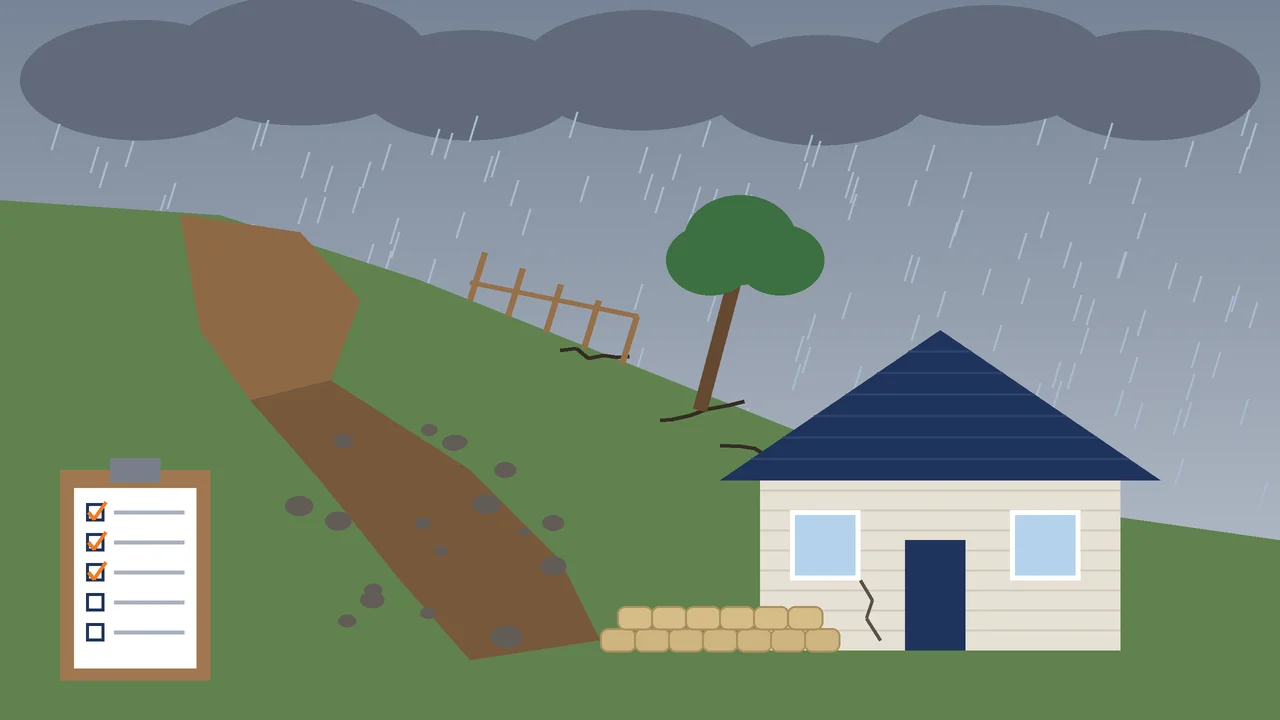
Ready.gov lists signs of a slow-moving landslide that threaten property: doors or windows that stick or jam for the first time; new cracks in plaster, tile, brick or foundations; outside walls, walkways or stairs pulling away from the building; slowly widening cracks in the ground, driveways or streets; broken underground utility lines; bulging ground at the base of a slope; water breaking through the ground in new places; and fences, retaining walls, utility poles or trees that tilt or move. Signs of a fast-moving slide or debris flow include rushing water or mud, unusual sounds like trees cracking or boulders knocking together, and a faint rumble that grows louder. The Washington Geological Survey adds sudden changes in creek or river levels, sometimes with more sediment, during or after big storms. If you notice these, leave and report it to your city or county emergency manager.
During a storm
Ready.gov says to follow local emergency managers, stay alert and awake during storms that could cause a landslide because many landslide deaths happen while people are sleeping, never cross a road or bridge with mud or water flowing or a flow approaching, and move uphill quickly if you're caught in the path. Near a stream, watch for a sudden rise or drop in water flow or water that turns from clear to muddy, which can signal a coming slide. Turn Around, Don't Drown applies to mud as well as water.
After a slide: safety before cleanup
Stay out of the slide area; more slides can follow. Ready.gov says floods sometimes follow landslides and debris flows, so watch for flooding; check for injured or trapped people near the slide without entering it and direct rescuers to them; report broken utility lines and damaged roads to authorities; and let trained professionals check the building foundation, chimney and surrounding land before you rely on them. For the longer term, it recommends replanting damaged ground soon and getting a geotechnical expert's advice before attempting any fix, so you don't create a new hazard.
Document it for your insurer
Once officials and a professional say it's safe, photograph and video the slope, the slide or mud path, where mud or water entered the house, the depth of mud on floors and walls, cracks in the foundation, walls and driveway, damaged fences and retaining walls, and damaged belongings, before cleanup. Keep samples of damaged materials, receipts for any emergency work, and a list of what was lost. FEMA's fact sheet says to contact your insurance agent or company right away after a flood loss, and that an NFIP-registered adjuster will inspect and decide whether the event meets the policy's definition of a flood. A home inventory made ahead of time makes this much easier.
How insurance usually treats landslides, mudslides and mudflows
The words matter. Triple-I separates mudflow, which acts like a river of mud and is covered by flood insurance (sold through the National Flood Insurance Program and some private insurers), from landslides, which count as earth movement and are excluded from standard homeowners and business policies, and from mudslides, a mass of earth or rock moving downhill, which it says generally aren't covered by any policy. FEMA's fact sheet says the NFIP's flood definition includes mudflow but that the policy does not insure earth movement, even when a flood causes it. Washington's insurance commissioner says homeowner insurance usually doesn't cover land movement or landslides caused by rain, snowmelt, flooding or earthquakes, and that flood insurance may cover some kinds of earth movement, such as mudflows, flash floods and erosion due to water. Some damage that comes with a slide, such as a broken water pipe or a tree that falls during a windstorm, may be a separate question under your policy, so report everything and let the insurer decide what applies. Only your insurer decides coverage.
Coverage to consider before the next storm
If you live on or below a slope, ask your agent three questions: does my homeowners policy exclude earth movement, do I have flood insurance (which may cover mudflow), and is a Difference in Conditions policy available? Washington's insurance commissioner and Triple-I say DIC policies typically include landslides, mudflows, earthquakes and floods and are usually sold by surplus lines insurers; Washington also notes a contents-only earth movement option that some insurers offer. Flood insurance doesn't start right away: FEMA says there is generally a 30-day waiting period before a new NFIP policy takes effect, so buy it well before the rainy season.
Reduce the risk on your property
The U.S. Geological Survey's preparedness advice: find out where your gutters, downspouts and driveway send water during heavy rain, and if it flows onto a slope, consider piping it to the storm sewer or road ditch (check local rules first); keep native vegetation on slopes; don't dump yard waste or debris on a slope; and, in areas with known landslide problems, hire a geologist or engineer with landslide experience to evaluate the property. Ready.gov adds that sandbags, retaining walls or K-rails may protect a property from mud or floodwater, but that you can't stop or change the path of a debris flow and may be liable if you divert one onto a neighbor's property. Talk with neighbors too; the USGS notes landslides don't respect property lines.
How we can help
ClaimToRepair makes the insurance side easier and gets the repairs done. Once the slope has been checked and it is safe to be on the property, one licensed local pro can do a free inspection, photograph and document the mud, water and structural damage, write an estimate you can share with your insurer, and handle cleanup, drying and repairs. We don't file, negotiate or adjust claims, and only your insurer decides what is covered. If mud or water is in the house right now and the area has been declared safe to enter, use Get immediate help: the same-day option has a $50 dispatch fee that is refunded if no one arrives the same day and isn't applied to the cost of the job, or you can schedule a visit instead.
Sources
- Ready.gov: Landslides and debris flow (before, during and after)
- U.S. Geological Survey: Landslide preparedness
- FEMA: Understanding mudflow and the NFIP (fact sheet, PDF)
- FloodSmart (NFIP): What flood insurance covers
- Triple-I: Insurance for landslides and mudflow
- Washington Office of the Insurance Commissioner: Landslide insurance
- Washington Geological Survey (DNR): Landslides
- California Geological Survey: Landslides and landslide maps
- Iowa Environmental Mesonet: archive of National Weather Service local storm reports
General information only, not legal or insurance advice. Coverage depends on your policy.
Get a free inspection and written estimateDamage happening now? Get immediate help
Free inspection, no obligation. You get photos and a written estimate to share with your adjuster, so you know the real repair cost before you decide whether to file a claim. We don't file, negotiate or adjust claims.