Tornado or Severe Wind Damage to Your Home: Safety First, Temporary Repairs, Storm Surveys and How Insurance Usually Works
Published
What to do after a tornado or severe thunderstorm damages your house: safety checks for gas, power lines and structure, how to document damage and make temporary repairs, what an NWS storm survey and EF rating mean, how homeowners policies usually treat wind damage, and how to vet contractors (with New Jersey and Delaware examples).
Does homeowners insurance cover tornado damage?
Short answer: Usually the wind damage, yes, subject to your policy's terms, limits and deductible. Triple-I says standard homeowners and business policies cover wind damage caused by tornadoes and severe weather, and that homeowners policies also provide additional living expenses if you need temporary housing. Flood is a separate policy, and damage to a car falls under the optional comprehensive part of an auto policy. Some policies, mostly in places with frequent windstorms and hail, carry a separate wind/hail deductible that is a percentage of the home's insured value (Triple-I says typically 1 to 5 percent), so check your declarations page. Only your insurer decides what is covered.
Do I have to wait for the National Weather Service to confirm a tornado before I report damage?
Short answer: No. NWS storm surveys decide how to classify the event (tornado or straight-line winds) and estimate wind speeds for the record; they are not part of your insurance claim. Triple-I says standard policies cover wind damage from tornadoes and severe weather, and New Jersey's insurance department tells homeowners to report a loss to their agent or insurer as soon as possible. Report the damage, protect the house, and keep documenting.
Can I make repairs before the adjuster comes?
Short answer: Make temporary repairs; hold off on permanent ones. New Jersey's Department of Banking and Insurance says to make necessary temporary repairs to protect the property from further damage (boarding broken windows, for example), that those expenses are usually covered, and to save every receipt; permanent repairs must wait until the adjuster has reviewed the damage. Photograph everything before and after, and don't throw away damaged property until the insurer has seen it or says you can.
How do I know a storm contractor is legitimate?
Short answer: Check registration or licensing and insurance before you sign. In New Jersey, home improvement contractor businesses, including out-of-state companies, must register with the Division of Consumer Affairs, carry at least $500,000 of general liability insurance, show their registration number on contracts, ads and vehicles, and use a written contract for jobs over $500. The National Weather Service also warns storm victims to be aware of insurance scammers. Get a written estimate and a written contract, and be wary of anyone who wants full payment up front.
The short version
After a tornado or a severe thunderstorm with damaging winds, the order is: people first, then hazards (gas, power lines, structure), then stop further damage, then document, then report and repair. The National Weather Service's post-tornado advice is to stay informed because more storms can follow, let family know you're okay by text or social media, stay out of damaged buildings, wear long pants, a long-sleeved shirt and sturdy shoes when walking through damage, contact local authorities about downed power lines, and be aware of insurance scammers.
Safety checks before you go inside
OSHA lists the hazards that injure people after tornadoes: structural, electrical and gas-leak hazards, downed power lines, falling limbs and poles, nails and broken glass, falls from heights, and generator and chainsaw accidents. If you smell gas, see sagging ceilings or walls, or see a line down, stay out and report it to the utility or local authorities. Ready.gov adds: stay clear of fallen power lines or broken utility lines, and wear thick-soled shoes, long pants and work gloves for cleanup. Don't climb onto a damaged roof yourself; a pro can tarp it safely.
Tornado or straight-line winds? Why it matters less than you think
Strong thunderstorms don't need a tornado to do serious damage: the National Weather Service says straight-line winds in strong thunderstorms can exceed 100 mph. After events like the Nov 12 storms in northern Delaware and South Jersey, NWS meteorologists run storm surveys to decide whether damage came from a tornado and to assign an Enhanced Fujita (EF) rating. The Storm Prediction Center explains that EF ratings are wind estimates based on damage, judged against 28 damage indicators that include one- and two-family homes, barns and outbuildings, and hardwood and softwood trees; an EF0 is roughly 65 to 85 mph gusts and an EF1 roughly 86 to 110 mph. That classification is for the weather record. For a typical homeowners policy the question is wind damage either way, so report the damage without waiting for the survey.
Stop further damage (and keep the receipts)
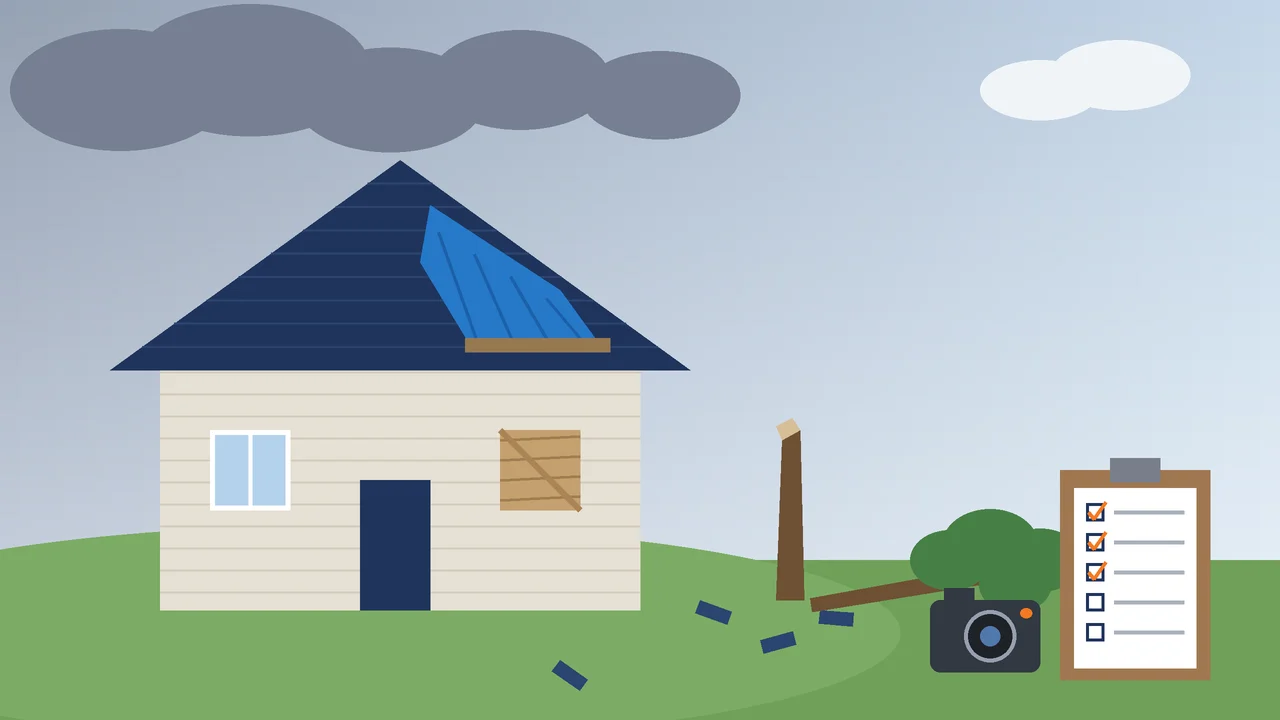
Your policy expects you to protect the property from more damage. New Jersey's Department of Banking and Insurance calls this mitigating your damages: make necessary temporary repairs, such as boarding broken windows or tarping a roof opening, save all receipts and bills, and wait on permanent repairs until the adjuster has reviewed the damage. If wind tore shingles or a tree punctured the roof, a tarp today usually prevents the much larger water damage that follows the next rain. If wires are involved or a tree is still on the house, leave it to the utility and a qualified crew.
Document it like an adjuster would
Before cleanup, photograph and video every side of the house, the roof from the ground, the attic underside if it's safe, fallen trees and where they landed, broken windows, siding, fences, sheds and vehicles. Take close-ups with a coin or ruler for scale if hail fell too. Then list what was damaged, with a separate list of things damaged beyond repair; New Jersey's insurance department says not to discard damaged property until the insurer has had a chance to inspect it, and to include purchase dates, prices and replacement costs where you can. A home inventory made before the storm makes this much faster, which is why Delaware's Department of Insurance recommends photographing or videoing each room ahead of time.
How insurance usually treats wind and tornado damage
Coverage depends on your policy, but the general pattern is consistent: Triple-I says standard homeowners policies cover wind damage caused by tornadoes and severe weather, homeowners policies include additional living expenses if you can't live in the house, and vehicle damage falls under the optional comprehensive part of an auto policy. Your deductible still applies, and some policies use a separate percentage wind/hail deductible (Triple-I says typically 1 to 5 percent of the insured value). Delaware's Department of Insurance also reminds homeowners to know whether they have actual cash value (after depreciation) or replacement cost coverage, and to ask whether additional living expenses are covered. Flooding from heavy rain is a separate flood-insurance question.
Working with the adjuster
Report the loss promptly and write down your claim number and the adjuster's contact information. New Jersey's insurance department says the adjuster inspects the damage and determines coverage, that you should keep written notes of conversations, that the company should give you a copy of its damage estimate, and that you are not required to use the insurer's recommended contractor. When a settlement is offered, it says to review the itemized estimate with your contractor of choice and raise questions before accepting. Having your own contractor's written scope and photos makes that conversation concrete. If you and the insurer can't agree, contact your state insurance department: New Jersey's consumer hotline is 1-800-446-7467, and Delaware's Consumer Services Division is 1-800-282-8611, with a homeowners arbitration program (a $50 filing fee and a three-person panel) available after informal attempts fail.
Vet contractors before you sign
Out-of-town crews arrive fast after a storm. In New Jersey, the Division of Consumer Affairs says home improvement contractor businesses, including out-of-state ones, must register annually, carry at least $500,000 of general liability insurance plus workers' compensation unless exempt, display their registration number on contracts, ads and vehicles, and use written contracts for jobs over $500. Wherever you live, check licensing with your state or local government, ask for proof of insurance, get the scope and price in writing, don't pay the full cost up front, and don't sign over your insurance check. New Jersey's insurance department also notes that public adjusters are licensed, are paid a percentage of the settlement, and are not required to file or resolve a claim.
How we can help
ClaimToRepair makes the insurance side easier and gets the repairs done. One licensed local pro can do a free inspection, photograph and document the wind, hail or tree damage, write an estimate you can share with your adjuster, and handle the temporary and permanent repairs. We don't file, negotiate or adjust claims, and only your insurer decides what is covered. If the roof is open or a tree is on the house right now, use Get immediate help: the same-day option has a $50 dispatch fee that is refunded if no one arrives the same day and isn't applied to the cost of the job, or you can schedule a visit instead.
Sources
- Ready.gov: Tornadoes (what to do after a tornado)
- National Weather Service: What to do after a tornado
- National Weather Service: Wind safety (straight-line winds)
- OSHA: Tornado response and recovery hazards
- NOAA Storm Prediction Center: Enhanced Fujita (EF) scale and damage indicators
- NOAA Storm Prediction Center: Preliminary storm reports, Nov 12, 2026
- National Weather Service Mount Holly (storm surveys and public information statements)
- Triple-I: Tornadoes and insurance
- Triple-I: Understanding your insurance deductibles (wind/hail deductibles)
- New Jersey Department of Banking and Insurance: Home insurance basics (what to do after a loss)
- New Jersey Department of Banking and Insurance: Guidance on filing insurance claims for storm-related damage (PDF)
- New Jersey Division of Consumer Affairs: Home improvement contractor registration FAQ
- Delaware Department of Insurance: Disaster preparedness tips for homeowners and renters
- Delaware Department of Insurance: Arbitration for homeowners insurance disputes
General information only, not legal or insurance advice. Coverage depends on your policy.
Get a free inspection and written estimateDamage happening now? Get immediate help
Free inspection, no obligation. You get photos and a written estimate to share with your adjuster, so you know the real repair cost before you decide whether to file a claim. We don't file, negotiate or adjust claims.